
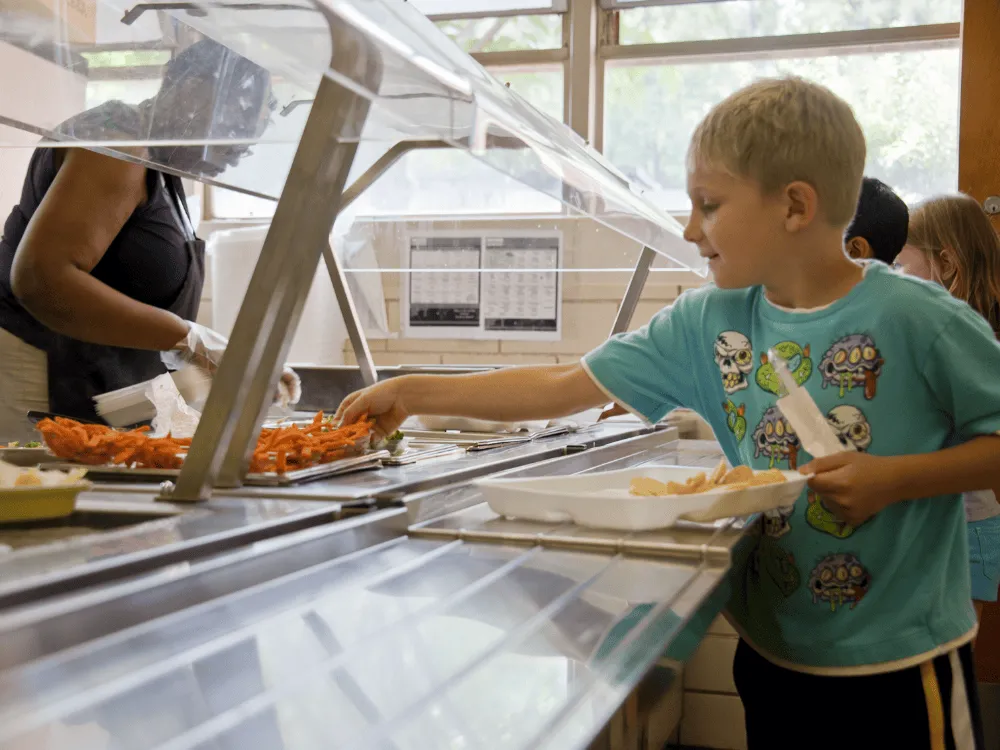
ReFED and World Wildlife Fund's September 26th webinar—"Reducing Food Waste in Schools: Transforming Cafeterias through Community-Driven and Grassroots Initiatives"—provided an opportunity for audience members to hear directly from educators and students about practical solutions they're using to cut the amount of food waste generated in K-12 schools in their communities.
During the session, WWF’s Alex Nichols-Vinueza led a discussion among five panelists about food waste prevention, recovery, and recycling in schools. Key discussion points included the extent of the problem, overcoming the barriers to implementing solutions, and perceptions of food waste among school administrators and students. Importantly, they also discussed specific strategies that audience members could leverage in their own schools.
Panelists included:
Advika Agarwal, Co-Founder of Compostology (opens in a new tab) and current student at Johns Hopkins University
Shrusti Amula, Founder of Rise N Shine Foundation (opens in a new tab) and current student at Georgetown University
Tara Happy, Environmental Sciences educator at Hollis Primary School in New Hampshire
Susanne Lee, Faculty Fellow at the Mitchell Center for Sustainability Solutions (opens in a new tab) at the University of Maine
Joe Richardson, Founder of Lunch Out of Landfills in Maryland
Throughout the webinar, panelists and attendees shared resources on reducing food waste in schools. Here is a list of those resources:
Join the Coalition to Re-Imagine School Waste (opens in a new tab)
K-12 Action Guide: Be A Food Waste Warrior (WWF) (opens in a new tab)
California's Organic Waste Law: SB1383 Fact Sheet (Replate) (opens in a new tab)
California's Climate Pollutant Reduction Strategy (CalRecycle) (opens in a new tab)
Share Table Video Walkthroughs (StopWaste) (opens in a new tab)
Food Waste Prevention and Donation at School (StopWaste) (opens in a new tab)
Food Waste Reduction Toolkit for Illinois Schools (Wasted Food Action Alliance) (opens in a new tab)
Bill Emerson Act Primer (Feeding America) (opens in a new tab)
Food Sharing Tables Guidance for Schools (Maine CDC Health Inspection Program) (opens in a new tab)
Share Fridge Signage Example (MCCPTA & Regenerative Solutions) (opens in a new tab)
Use of Share Tables in Child Nutrition Programs (USDA) (opens in a new tab)
Food Rescue Maine Study (Mitchell Center for Sustainability Solutions) (opens in a new tab)
Important note: These resources have not been vetted by ReFED.
ReFED is a U.S.-based nonprofit that partners with food businesses, funders, solution providers, policymakers, and more to solve food waste. Its vision is a sustainable, resilient, and inclusive food system that makes the best use of the food we grow. The organization serves as the definitive source for food waste data, providing the most comprehensive analysis of the food waste problem and solutions to address it. Through its tools and resources, in-person and virtual convenings, and services tailored to help businesses, funders, and solution providers scale their impact, ReFED works to increase adoption of food waste solutions across the supply chain.


Find more news and updates from the ReFED blog.